

This is the fourth post in a series I’m writing about health anxiety and chronic pain, a chapter of my life that I’m now on the other side of. If you missed the previous posts, start here.
I thought good news was supposed to make me feel better.
After a month of waiting, worrying, and freaking out, the biopsy results were clear: I didn’t have cervical cancer (read my last post here if you missed it).
I cried myself to sleep the night I received the news, my tears a blend of gratitude and emptiness that I couldn’t quite explain.
It was time to get on with my life. This chapter could close, and I was ready for things to go back to normal.
But as the days passed after the biopsy results, the positive news from my doctor wouldn’t sink in.
At least, not in the ‘wow, I feel so much better’ kind of way.
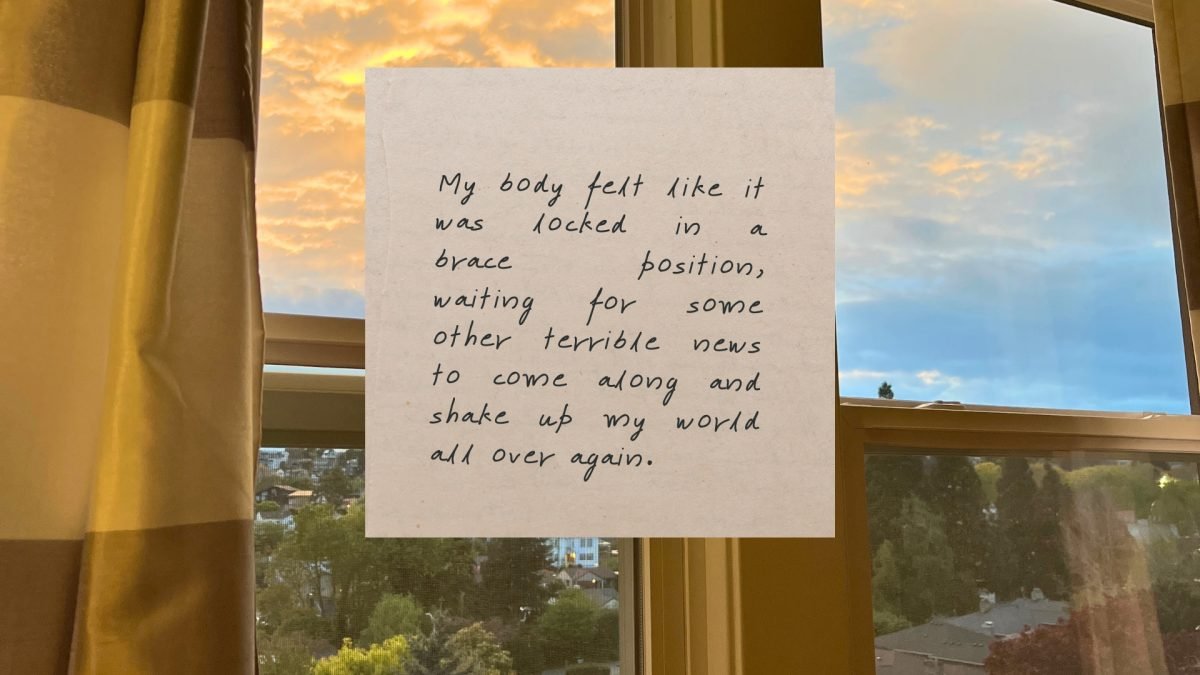
It felt like I was locked in a brace position, waiting for some other terrible news to come along and shake up my world all over again.
That one-month period of being in a heightened state of fear was over, but my body wouldn’t come down from it.
Time to move on
Soon I was hit by the numbing realization that I didn’t even know what was next for my life.
I’d moved to another state where the only people I knew were my parents. I was still grieving a breakup and trying to make sense of what went wrong. My contract work projects were getting fewer and farther between.
I had no anchor, nothing tethering me to the ground. I felt like a torn-up rag doll that needed to be sewn back together.
Any time I thought about the future, a wave of pain would ripple through my body.
A burning sensation wrapped around my upper thigh. The right side of my pelvis felt tight and twisted after I’d injured it during a workout.
And my lower back ached for my attention, something I’d been dealing with for three years. It didn’t help that during a physical therapy class, an older woman said I was too young to have back pain.
Despite the all-clear from the doctor, I couldn’t shake the feeling that something was still wrong with me.
The fixer mentality
Though I had no idea what the future held, I figured if I could get rid of this pain, THEN I could finally move on with my life.
I had nothing else going for me at this point, or so it seemed.
What better time than to fix myself?
This mentality to fix everything came naturally to me.
I’m really good at solving problems, you see. I was used to putting out fires, often for other people. Sometimes I would even go looking for problems because at least then I could solve them and keep my brain occupied.
So, with that mentality locked and loaded, I was going to figure out how to fix this pain.
At this point in the story, I wish I could have listened to the tiny voice within me that said:
Please let your body rest. Please stop searching for answers. Please do nothing for a little while. Please be patient. Please let go of needing to know the answers. Please do something that brings you joy, just because.
But alas, I went a different route.
The new morning routine
My thoughts circled my doctor’s nonchalant suggestion that my pelvic pain could be my lymph nodes. Google also gave me a whole host of possibilities, like lymphoma, endometriosis, a UTI…
Every time I read the symptoms for a different diagnosis, my body would tense up. Hours later, I’d wonder why my lower back pain was horrendous.
All I wanted to do when I woke up in the morning was read a book in bed, but my back and pelvis would cry out and distract me from reading a single page.
Instead, I found myself with a new morning routine, and not the ‘calm, peaceful, connected to my highest self’ kind that I would have liked.
No, this was a ‘poke my body’ kind of morning routine.
Each morning after I woke up, I’d press deep into my skin in hopes of finding a lump or trigger point to explain this pelvic pain. I’d even poke other parts of my body to make sure everything still felt ‘normal’.
Then I wondered if poking myself was making the pain worse. What if I was causing this pain? What if this was all my fault? (I couldn’t see that blaming myself was making everything worse.)
I made a deal with myself at night: I would not poke my body tomorrow.
But the deal didn’t hold. By the next day, I was doing it all over again.
The nudge that I ignored
Then the universe gave me a sign. (That’s how I’m interpreting this. It was most likely just YouTube’s algorithm.)
A video popped up in my feed:
You need to stop checking your lymph nodes.. here’s why.
Was I on The Truman Show?
I watched hesitantly as the woman in the video, Cherelle, talked about how she found a bean-sized lymph node in her groin.
She would check it often, feeling the lymph node to see if it had changed size. When it hadn’t grown, she felt relieved… but five minutes later, she was checking it again.
This sounded eerily familiar.

For Cherelle, this turned into a six-month spiral where she was convinced she had lymphoma.
Except she didn’t have lymphoma… or any other health problem for that matter.
She had health anxiety.
This is the point where I could have stopped. I had an answer: health anxiety. But if that were the case, why did the pain in my body feel so real? (I would later find out why.)
I wish that video could have been the turning point. Or rather, I wish I could have believed it. But I couldn’t accept that this was anxiety.
Black-and-white thinking
Instead of listening to Cherelle’s advice to stop Googling symptoms, I convinced myself the pelvic pain was a UTI.
Once the idea was planted, I could not get it out of my head.
Why was my mind so easily distracted most of the time, yet hyperfixated in other moments? Why couldn’t I control what it focused on?
I understand now (with the help of a therapist) that I was deep in black-and-white thinking (also called all-or-nothing thinking).
With black-and-white thinking, the mind latches on to a thought so intensely that it becomes the only option in sight. Once the idea is planted, the mind can’t entertain any other possibilities.
Instead of seeing that there are an infinite number of explanations for something, the mind can only see good or bad, success or failure, normal or abnormal.
My mind couldn’t handle the uncertainty of not knowing what the problem was, so black-and-white thinking gave it a false sense of certainty (and therefore control).
If I could take the test, at least I’d know for sure whether a UTI was the cause of my pain. I thought I should wait it out, but I had to know.
My wise mind was no longer in the driver’s seat.

The false relief
Because I couldn’t get the UTI idea out of my head, I made a plan to get an at-home test.
I rushed downstairs and snuck out the door to drive to Target before my mom could ask where I was going, truly feeling like a teenager in that moment at the ripe age of 33. She’d probably tell me I was overthinking it since I’d already reported all of my Reddit findings to her, convinced everything was wrong with me.
I felt like I was doing something I shouldn’t.
Perhaps that was my mom’s voice in my head. Or maybe it was my own voice of reason yelling at me: “Did you forget about that health anxiety video you watched??”
On the cloudy-headed drive to the store, part of me desperately wished my mom had caught me before I left. I needed someone to stop me. I couldn’t trust myself, apparently.
But when I got home and saw that the results were positive, I wanted to punch the air. I was actually right.
I had a diagnosis for my pelvic pain.
I felt relieved. Confused, but relieved.
Maybe this pelvic pain was a UTI all along. Maybe this truly wasn’t health anxiety. Maybe I was on to something here.
Until I actually read the instructions and realized I should have tried first thing in the morning for accurate results…
When I peed on the stick the next morning, it was negative.
Was I back at square one?
Maybe I was right
I called my healthcare provider, trying to sound cool and collected as if I wasn’t spiraling downwards. I needed some sort of confirmation.
The nurse paused after hearing my symptoms. ‘Okay… I guess I can book you for a urine test,’ he said, skepticism in his voice.
That urine test came back positive.
I frantically called my doctor, trying to get ahold of her before the weekend.
The right side of my stomach started cramping. My mind jumped straight to the worst-case scenario… What if it was my appendix?
When my doctor heard my symptoms, she threw out an off-handed comment about a twisted ovary or kidney stone (why did doctors keep throwing out scary suggestions as if they meant nothing?).
But after seeing my urine results, she prescribed antibiotics instead.
Antibiotics. Cool. I could do that. It was time to tackle this baby head-on.
For the first time since before my initial pap smear results, I breathed a sigh of relief. This was all going to be over soon.
Spoiler alert: it was not over soon.
The panic attacks
The next day, after I’d already taken two doses of antibiotics, I received a message from an OBGYN:
“Your urine results look normal. No need for antibiotics.”
Sorry… what? Why did my doctor say I needed them? Should I be taking these things or not?
I Googled what could happen if you take antibiotics when you don’t need them, bile rising in my throat as I realized this pelvic pain might not be a UTI after all.
As I lay in bed that night, my thoughts swirled around the side effects of antibiotics and how they could destroy the good bacteria in my gut.
My back started seizing in a way I’d never felt before. It was as if someone was pressing their full weight into my back while rubbing shards of glass into my muscles.
I couldn’t lie down in any position without my back screaming at me. After hours of rolling around, my body started shaking uncontrollably. I was shivering all over, yet my limbs felt like they were on fire.
I almost called out to my mom at 2 am to have her take me to the ER. I genuinely thought I was dying.
As much as I tried deep breathing and meditation, they were no match for whatever was happening in this moment. This felt like more proof that I couldn’t trust my own body.
I had no idea at the time, but I experienced two back-to-back panic attacks that night.
I was completely oblivious to the connection between Googling my symptoms and having a total breakdown. And it was going to happen again until I could see things more clearly.
The morning after

The day after the panic attacks, I woke up feeling like I was going to throw up. I stumbled to the bathroom to grab the trash can and place it next to my bed, just in case.
My body was exhausted from shaking all night.
My mom came into my room to ask if I wanted to get coffee for our usual Sunday morning ritual. When she saw the trash can next to my bed, a wave of disparagement came over her face. I imagined she was thinking what I was thinking: that I was overreacting, and this was all in my head.
I called my healthcare provider once again, my outgoing call list starting to look like someone desperately trying to contact an ex for answers. I needed someone to confirm that I wasn’t losing it.
Did I need to take antibiotics or not? The answer was no.
I’d just had panic attacks over something I didn’t even need. I felt like I was slipping into madness. I’d gone through this mess, and I was STILL in pain and didn’t know what was causing it.
Was this really health anxiety?
At this point, I would’ve rather had a UTI than be back at square one.
The doctor on the phone, perhaps taking pity on me, booked me an appointment the next week with another OBGYN to get my pelvic pain checked out.
I felt hopeful that I could finally get some answers.
Though I’d told my mom no to coffee, I couldn’t stand the thought of being in bed all day. I’d only spiral further.
So I got dressed, went to the coffee shop, and played along with the Sunday ritual. While I sipped my tea, I pretended I hadn’t felt on the verge of death last night and tried to ignore the nauseating pain radiating from my pelvis.
The search continues
The search to figure out what was causing my pain had to continue.
And, oh boy, did the search continue.
A few days later, I was back in the exam room having an internal ultrasound.
I closed my eyes and braced myself, scenes from the biopsy re-entering my mind — the smell of metal, gripping the table with sweaty hands, and the feeling of being a scared little child.
The OBGYN pushed the long wand deep into every crevice. I held my breath as images of my cervix appeared on the screen, awaiting some large object to come into view that would finally explain my pelvic pain.
“Things are healing nicely from the colposcopy”, the doctor said with a smile. “I don’t see anything of concern.“
With both hands, she pushed firmly on my stomach, her strength for such a tiny woman taking me by surprise. “It’s probably a tight psoas muscle”, she concluded.
Then, as she turned to leave, she left me the advice I may have needed all along:
“Try to relax more.”
I left the appointment feeling relieved that this was nothing serious.
I have proof I’m okay
Maybe Cherelle was right this whole time. Perhaps this was nothing more than health anxiety.
Maybe I did need to loosen my grip on my need for certainty.
I wasn’t sure how to settle into a place of surrender, considering that meant fighting against the part of myself who wanted to fix everything myself, but at least I could try.
Now I had proof that everything was okay… but could I trust it?
The next post is about how having proof and feeling safe turned out to be two different things. Subscribe below to be notified when the next post is published.
Disclaimer: This post documents my personal journey with health anxiety and chronic pain and should not be taken as medical advice.