

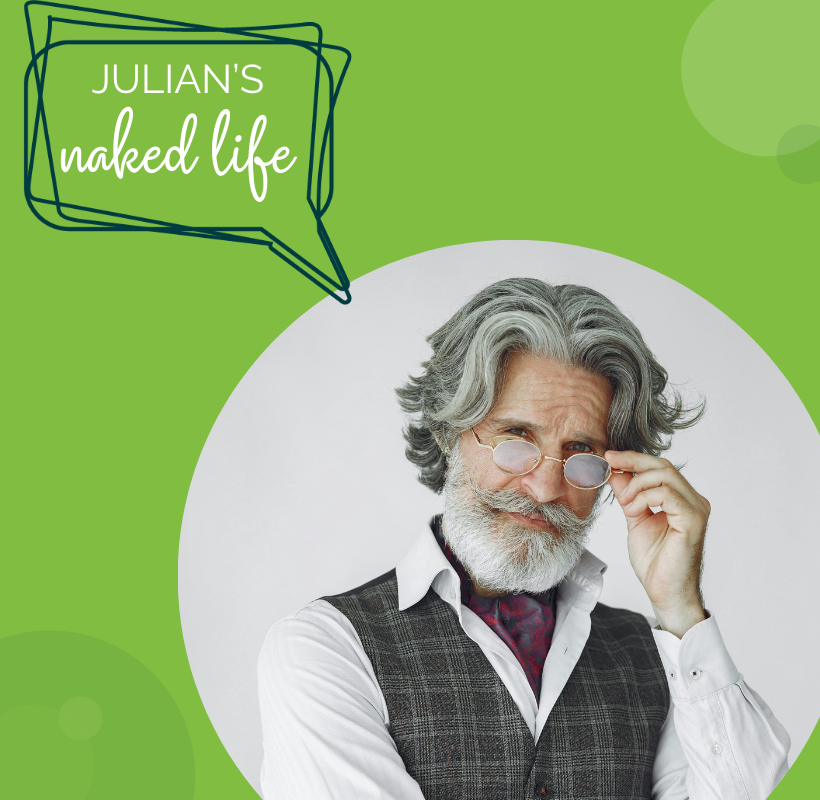
I know what it is to wonder whether it’s too late for any of this to matter. I hear it every week from people in their sixties and seventies who have drunk this long, been fine, and can’t picture what they’d get back. We lose body water and lean mass as we age, so the same drink lands harder than it did at 40. Drinking problems in older adults are also more likely to go unrecognized, by doctors and by the people living them. Julian is 71, he never hit a rock bottom, and he knows exactly what he got back.
— Annie Grace
Is it worth quitting drinking at 70, when nothing has fallen apart and the habit has fit inside a full life for five decades? Julian asked himself that after a month in rehab, two years of creeping consumption, and a growing sense that alcohol was occupying space he wanted for something else. What he found on the other side wasn’t expected at all. It was the welcome return of feelings he’d stopped trusting could exist for him at all.

Drinking Was the Grown-Up Thing to Do
My father drank a little till I was about ten, then he started drinking daily. I think we were aware that he drank because he wasn’t happy, but it was obvious it didn’t help. I didn’t care much for alcohol as a teenager. Then at around 20 it seemed like the more adult, sophisticated alternative to smoking weed. It had some romantic aura. After that I was in a work environment where daily drinking was a rite of passage, and holding your drink gained you kudos. So I held my drink.
Why I Kept Going Back After Stopping
I just stopped a few times. The trouble was I didn’t know to replace it with anything, so I quickly went back, in a matter of weeks or months. In 2022 I went to rehab for a month, and that was brilliant, but I hadn’t learned enough tools or investigated my Why. Over a couple of years of slowly increasing consumption, once a month became several times a week. Dr. John Cooper Clarke described substance abuse this way: “First it’s fun, then it isn’t, then it’s hell.” I decided I needed more training.
Is It Worth Quitting Drinking at 70?
People my age tend to ask a version of the same thing. Is it worth quitting drinking at 70, this late in the day? I’ve never hit any of the usual rock-bottoms. What I have is a coping strategy that stopped working a long time ago and still takes up room. At 71 my work has to be to drop this ineffective coping strategy to win back the mental and spiritual space it takes up. For me, that’s the whole answer to whether it’s worth quitting drinking at 70. The space alone is worth it.
I read This Naked Mind amongst a lot of quit-lit, and it was the most complete, logical and factual book of them all. It laid it all bare: the drug, the industry, society, and me. It put everything in relationship to everything else and explained why I could stop blaming myself and belittling myself. Of course, I still did. But I knew my best bet was to pursue this knowledge-based, compassionate route, the Path. I bought into it, committed time and money, stuck with it, and it has touched all the important parts of my life. I can’t imagine needing more information. I have community to support me too, and that community also values my contribution to it. This was an injured area for me, and it is being healed and reinforced daily.
What Happens When You Start Feeling Again
I feel. I detect my emotions instead of dialing them down. I have experienced real joy, contentment, gratitude and love, things which I had not trusted could exist for me for a long time. That’s like the clouds parting. They may cover the sky again. They will and do. But I know I have access to what’s behind them. I don’t need to achieve anything more on Earth. When someone asks me whether it’s worth quitting drinking at 70, that is what I tell them.
With the Path, so many of the teachings have become truisms. When I go back to Year 1’s sessions I can remember them as being surprising, even difficult, such as “we were just doing the best we could with what we had.” The shame lifted, compassion set in. The habit of pausing to respond. The release from the pointless effort to change other people. Cutting back on judgement. Not believing every thought that comes into my head. Cutting knots with ACTs! We’ve changed how we look at the world, and it’s a different world. The past is a foreign country.
Leaving Alcohol Is Like a Divorce
It keeps coming back to me, how like a divorce or difficult break-up this is. Even though you knew they were bad for you, it took so long to flip the switch and end it. And then after the split, so long obsessing, unable to let go. Reminders everywhere, regrets, trauma, all bundled up into doubt and pain. Until one day you thought to yourself, in a revelation, “What am I letting go of? Nothing worth having!” And you sensed liberation and joy again. It will come. Time heals all wounds.
If I could tell my old self one thing, it would be this. You know the way. You’re not lost. You’re not broken. Trust your self.

Start Reading
You can stop drinking at 70! Get started by reading This Naked Mind. Get the first chapter for free here.
Share Your Story
Did you change your relationship with alcohol through our books, the app, the podcasts, or another program at This Naked Mind? Please share your story (as yourself or anonymously) and inspire others on their journey!
FAQ
Q: Is it worth quitting drinking at 70?
A: Yes, and the payoff tends to arrive faster than people expect. Older adults carry less body water and lean mass, so alcohol produces higher blood concentrations from the same amount, which is why the NIAAA sets lower recommended limits for people 65 and over. Removing it gives back sleep, steadier mood and mental clarity within weeks, alongside the emotional space Julian describes.
Q: Does alcohol affect you more as you get older?
A: It does. After 65, lean body mass and water content drop and metabolism slows, so alcohol stays in the system longer and hits harder than it did decades earlier. Older adults are also more sensitive to its sedative effects and more likely to be on medications that interact with it, which raises the risk of falls and injury.
Q: Can you quit drinking if rehab didn’t work the first time?
A: Yes. Julian’s month in rehab in 2022 helped, but he left without enough tools and without having examined why he drank, so consumption crept back over two years. Drinking again after a break is common and is best treated as information about what was missing, which for Julian was ongoing education and a community rather than a one-time intervention.
Q: What is The Path from This Naked Mind?
A: The Path is This Naked Mind’s coach-guided program built on Annie Grace’s research into why people drink and what happens when they stop. It works through daily content, live coaching and a member community rather than rules or willpower, and members revisit its lessons over the long term; Julian still returns to his Year 1 sessions to see how much has shifted.
About the Founder

Annie Grace is the bestselling author of This Naked Mind, The Alcohol Experiment, and Live Naked AF, and the founder of This Naked Mind. At 26, she became the youngest vice president at a multinational corporation; by 35, she was overseeing marketing across 28 countries — and drinking close to two bottles of wine a night. Rather than accept a life of willpower and white-knuckling, she developed Affective Liminal Psychology — a framework rooted in neuroscience and the psychology of desire — and found a way out that required no labels, no rock bottom, and no deprivation. Today, her work has been featured on Good Morning America and Nightline, and has helped millions of people worldwide discover what she calls alcohol freedom.
Copyright © 2026 This Naked Mind. This material is original content and is protected by international copyright laws. Unauthorized reproduction or distribution of this content will be met with legal action.